

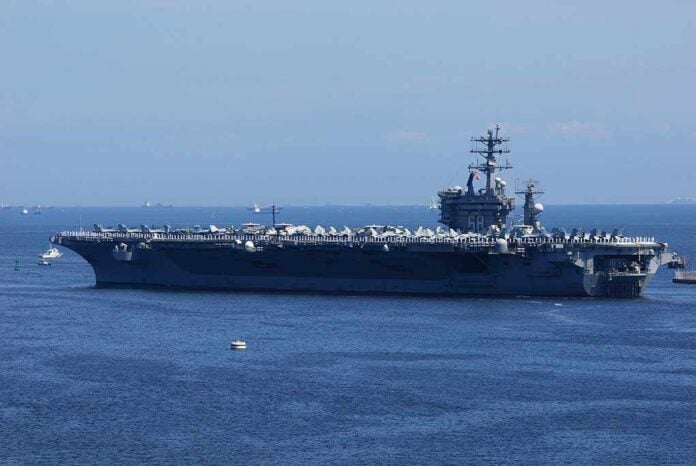
A looming undersea firepower gap is exposing how years of Pentagon missteps and “peace dividend” thinking left America’s Navy without a real replacement for four of its most lethal missile submarines.
Story Snapshot
- Four Ohio guided‑missile submarines with 616 Tomahawk cells are set to retire with no equal replacement.
- Planned Block V Virginia submarines carry far fewer missiles and are already behind production goals.
- The Navy faces a loss of 2,080 vertical launch cells when these subs and key cruisers leave service.
- Industrial delays and old political choices now threaten U.S. war‑fighting strength in a real shooting war.
What These Four Submarines Do That Nothing Else Can
For years, four Ohio‑class guided‑missile submarines have been the Navy’s hidden sledgehammer, each able to carry about 154 Tomahawk cruise missiles for surprise strikes at the very start of a war.[3][9] These boats—Ohio, Michigan, Florida, and Georgia—were converted from older ballistic‑missile hulls but became unmatched conventional strike platforms.[6][9] Together, they pack 616 missile tubes under the sea, ready to hit enemy air defenses, command centers, and key bases before the enemy can react.[3] No other platform combines that firepower with the same stealth.
Now those four submarines are scheduled to retire between about 2026 and 2028, because their original nuclear‑deterrent hulls are aging out and the Navy planned years ago to draw down the Ohio fleet.[3][13] Defense planning documents and shipbuilding plans show these retirements were not a surprise; they were baked in long before today’s conflict put undersea strike power to the test.[3][17] The problem is that Washington never fielded a true one‑for‑one replacement before green‑lighting those retirements.
The Navy’s Official “Replacement” Falls Short In Hard Numbers
On paper, the Navy’s answer is the Virginia‑class Block V attack submarine with the Virginia Payload Module, an extra hull section that boosts missile capacity from 12 to about 40 Tomahawks.[2][6] The Navy and Congress long described these Virginias as the way to “take on conventional strike missions” as the Ohio guided‑missile submarines leave service.[3] That sounds fine until you do the basic math: 40 missiles on a Block V versus 154 on an Ohio guided‑missile submarine means you need almost four Virginias to equal one retiring boat.[3][5]
Even worse, those Virginia Block V boats are not arriving on time or in enough numbers. A recent congressional look at the program found that, while the Navy planned to buy two Virginias per year, the shipyards have fallen short of that goal.[2] Separate reporting on the wider submarine force warns that older attack submarines are leaving the fleet faster than new Virginias can replace them, shrinking the attack‑submarine force through the 2030s.[2][9] That means the Navy is trying to plug a huge missile gap with ships that exist mostly on PowerPoint slides and late delivery schedules.
A 2,080‑Cell Firepower Hole Created By Old Mistakes
The guided‑missile submarines are not the only ships on the chopping block. Navy planning and outside analysis show that, as four Ohio guided‑missile subs and around a dozen Ticonderoga‑class cruisers retire, the fleet will lose about 2,080 vertical launch cells, the biggest hit to strike capacity since the Cold War.[1][11] These are the tubes that fire Tomahawks and other key missiles in any serious fight. A recent fleet review warned this could leave planners scrambling to cover basic war plans in the next decade.[1]
Experts who have studied the submarine industrial base say this crunch did not come out of nowhere. After the Cold War, leaders chased a “peace dividend,” cut submarine numbers, and let the nuclear shipbuilding base atrophy.[5][8] Hundreds of suppliers vanished, dry dock space shrank, and skilled workers left for other fields.[8][9] Today, the Navy is short both dry docks and workers, and it cannot ramp production from roughly one and a half submarines per year to the three or more per year many analysts now say are needed.[9] That is the bill coming due for decades of wishful thinking and misplaced priorities.
War Has Exposed How Risky The Old Plan Really Was
In calmer times, Pentagon planners argued that the guided‑missile submarine mission could be “spread around” to other submarines, surface ships, and aircraft, even if the total missile count dipped for a while.[3] They treated the loss of 616 Tomahawk tubes as an acceptable risk during a managed transition. But real conflict has a way of testing theories. High‑end war has shown just how valuable a stealthy, mobile, deep magazine is in the first days of fighting, when fixed bases are under fire and air defenses are thick.[3]
Public sources admit something important: there is still no open, detailed Navy study proving that Virginia Block V submarines and other platforms can fully absorb the guided‑missile submarine’s wartime workload.[3] The Navy’s own industrial‑base and shipbuilding plans now concede that production delays and budget pressures could leave an uncomfortable gap before enough new hulls arrive.[1][16] In simple terms, past leaders bet that the world would stay quiet while they retired unique weapons first and built replacements later. That bet is not aging well.
What Conservatives Should Watch—and Demand—Next
For conservatives who care about strong defense, limited but focused spending, and peace through strength, this is a textbook case of how not to manage vital assets. Washington found money for woke training and bloated domestic programs, while letting critical shipyards, dry docks, and missile capacity fall behind.[8][9] Now, as the Trump administration pushes to rebuild real war‑fighting power, it must wrestle with bad choices made by earlier globalist, budget‑cutting elites who saw the Navy as a bill‑payer.
Key questions deserve straight answers. First, will the Pentagon slow or stagger guided‑missile submarine retirements until Block V Virginias are actually in the water, armed, and deployed? Second, will Congress fund the shipyard expansions and workforce growth needed to get submarine deliveries up to the three or more boats per year that experts say are required to close the gap?[9][16] Third, will the Navy release enough data—at least in broad form—to show taxpayers and warfighters that war plans still work without these unique boats?
Sources:
[1] Web – The U.S. Navy Spent Years Planning to Retire These 4 Missile …
[2] Web – Unfixable Firepower Gap: The U.S. Navy’s Is Losing an Entire Class …
[3] Web – Fact Sheet: The Ohio-Class Replacement Ballistic Submarine Program
[5] Web – Columbia-Class Submarines
[6] Web – Ohio-class submarine – Wikipedia
[8] Web – US Navy to replace Ohio-class submarines with Columbia-class
[9] Web – The retirement of four Ohio-class guided-missile submarines could …
[11] Web – Navy Faces Missile Gap As Ohio Submarines Retire – Evrim Ağacı
[13] Web – US Navy to Retire Powerful Ohio Class Guided Missile Submarines
[16] Web – US Navy faces largest strike capacity loss since Cold War – Facebook
[17] Web – U.S. Navy goes All In on Submarines in Released Shipbuilding Plan
© newsworthy.news 2026. All rights reserved.