After Iranian missiles targeted two U.S. Navy warships, U.S. forces struck three Iranian oil tankers to raise the cost of future attacks, escalating risks in a key energy chokepoint.
Story Snapshot
- CENTCOM said the strikes were retaliation for Iranian ballistic-missile attacks on U.S. ships.
- No U.S. casualties were reported; two tankers were disabled and one was destroyed, reports said.
- U.S. officials linked the tankers to a “shadow” financing network for Iran’s Guard Corps.
- Oil route security and legal questions now collide in the Strait of Hormuz.
What The U.S. Military Says Happened
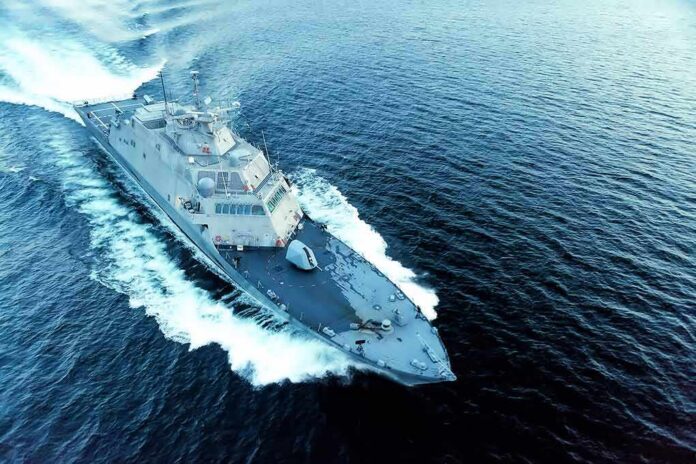
U.S. Central Command (CENTCOM) said American forces hit three Iranian oil tankers after Iran fired ballistic missiles at two U.S. Navy warships in or near the Strait of Hormuz. CENTCOM said the warships dodged the strikes and suffered no casualties. U.S. officials framed the action as deterrence and protection for civilian crews on commercial ships in international waters. Vice Admiral Brad Cooper said that if Iran shot at two U.S. ships, it would face higher economic costs in return.
Coverage described a measured use of force on at least two tankers. Reports said U.S. aircraft struck smokestacks or stern machinery to disable them, rather than sink them outright. One tanker was destroyed, though public sources did not include a battle-damage report explaining why disablement was not used in that case. CENTCOM also said the targets were part of a “shadow network” that funds Iran’s Islamic Revolutionary Guard Corps and its proxies, tying the ships to a military support system.
Iran’s Response And The Legal Dispute
Iran’s foreign ministry called the U.S. strikes a “flagrant violation” of international law and a breach of a ceasefire understanding dated April 8, and vowed a response to defend sovereignty. Iran’s Islamic Revolutionary Guard Corps said its earlier naval and air attacks were retaliation for recent U.S. strikes against Iranian interests near the strait. These claims set up a legal clash: the U.S. frames self-defense and deterrence, while Iran frames unlawful force and ceasefire breach.
Key gaps remain in the public record. The U.S. has not released the intelligence that links each tanker to Guard Corps financing, such as ownership and payment trails. The legal basis is also not fully disclosed; there is no visible war powers notice or detailed law-of-armed-conflict memo in the current reporting. The chain of evidence for the triggering missile attack lacks sensor logs and a full timeline in open sources. These limits keep the debate open while facts trickle out.
Why This Matters For Americans
The Strait of Hormuz carries a large share of the world’s oil and gas. When ships face danger there, prices react fast. Recent reporting shows traffic through the strait slowing during rounds of strikes and counterstrikes, raising shipping risk and cost. For families and small firms already stretched by energy prices, any new shock feels like the system failing them again. People on both the right and left worry that decisions in Washington are made with little transparency and heavy spin.
Both parties say they want safe seas and lower prices, but the path is hard. If the U.S. shows weak resolve, Iran may push harder on shipping. If the U.S. hits more targets, Iran may answer with more missiles and drones. Either path can raise insurance rates, reroute cargo, and lift pump prices. That is why many citizens say the government must show clear goals, clean rules, and honest updates. Vague statements feed the sense that elites decide, while the public pays.
Signals Of A New Deterrence Doctrine
U.S. messaging stressed a direct cost exchange tied to Iran’s behavior. The quote attributed to CENTCOM’s naval leader — “If you shoot at two of our ships, we will impose an even higher economic cost, taking out three of yours” — set a simple rule meant to be clear to Tehran and to shippers. Reports of calibrated disablement on two tankers also suggest a signal: the U.S. can raise costs without mass loss of life or a sunken fleet.
Lies, lies and damnable lies. All U S ships repelled all weapons sent against them and the US struck 3 Iranian tankers as a retaliation and threatened to wipe out ALL their tankers if the US ships were attacked again.
— James Smithton (@SmithtonJames) September 6, 2026
Yet clarity in slogans is not the same as clarity in law or facts. To rebuild trust, the government could publish more: target packets, ownership links, and the legal review that greenlit strikes on civilian-flagged tankers tied to a military network. Releasing more verifiable data would help Congress do oversight and help the public judge claims. That level of sunlight would not only test this case, it could also deter false narratives the next time the strait heats up.
Sources:
taskandpurpose.com, centcom.mil, gulfnews.com, axios.com, cbc.ca
© newsworthy.news 2026. All rights reserved.