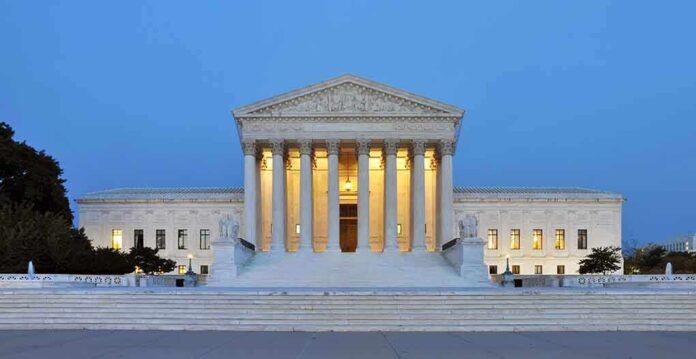
In a move that could reshape the political landscape, the Supreme Court reexamines Louisiana’s redistricting map, challenging the balance between racial equity and constitutional rights.
Story Highlights
- Supreme Court orders reargument in pivotal Louisiana redistricting case.
- The case tests the limits of the Voting Rights Act and Equal Protection Clause.
- Outcome could affect 2026 midterms and future of minority representation.
Supreme Court Revisits Louisiana’s Redistricting Controversy
The Supreme Court is once again tackling the contentious issue of Louisiana’s congressional redistricting map. The case, Louisiana v. Callais, questions the constitutionality of creating two majority-Black districts. This decision has far-reaching implications, not only for Louisiana’s 2026 elections but also for national redistricting laws. The Court’s rare move to order a reargument underscores the case’s importance.
The legal battle began in 2022 when Louisiana’s legislature passed a map with only one majority-Black district. Federal courts flagged it for likely violating the Voting Rights Act (VRA). In 2024, the legislature introduced a new map with two majority-Black districts. Opponents argue that this remedy prioritizes race, potentially infringing the Equal Protection Clause. The case now tests how states can address racial equity without overstepping constitutional boundaries.
Implications for the 2026 Midterms
The Supreme Court’s upcoming decision could directly impact the 2026 midterm elections. If the current map stands, it could alter Louisiana’s congressional delegation and shift the state’s political dynamics. The ruling will also set a precedent for how other states use race in redistricting, potentially influencing nationwide election outcomes. As the nation approaches the midterms, the stakes have never been higher for both political parties and minority communities.
For Louisiana’s Black voters, the case is a critical juncture. Their representation in Congress could be significantly affected, depending on the outcome. Civil rights groups, such as the NAACP Legal Defense Fund, argue that the remedial map is vital for ensuring fair representation and adhering to the VRA. However, some state officials view the map as unconstitutional racial gerrymandering, highlighting the complex balance between civil rights and constitutional limits.
Broader Impact on Voting Rights and Redistricting
The outcome of Louisiana v. Callais will likely reshape the landscape of voting rights and redistricting laws nationwide. A decision against the map could further restrict the application of the VRA, limiting states’ ability to use race as a factor in districting. Legal scholars warn that such a ruling could weaken protections against racial vote dilution, affecting minority representation across the country. The case exemplifies the ongoing national debate over the scope and future of the VRA.
As the Supreme Court prepares for reargument, all eyes are on the justices who will ultimately decide the case’s outcome. Their decision will not only shape Louisiana’s political future but also influence how states across the nation approach redistricting amid evolving legal and social landscapes.
Sources:
NAACP Legal Defense Fund, “Louisiana v. Callais – Legal Defense Fund”