Gavin Newsom’s “960 SAT” confession has gone viral for a reason: it spotlights how California’s political class can celebrate “progress” while basic literacy and readiness numbers still lag.
Story Snapshot
- Gov. Gavin Newsom ad-libbed during his final State of the State address that he scored a 960 on the SAT and struggles to read written text.
- Available source material ties the remarks to the State of the State setting—not to a specific “Black crowd,” despite viral framing online.
- California reported test-score improvements for 2024–25 and highlighted new literacy-focused legislation, AB 1454.
- State data still shows a major gap: about 9 in 10 students graduate, but only 51.7% meet California’s college-and-career readiness benchmark.
What Newsom Actually Said—and Where the Viral Framing Breaks Down
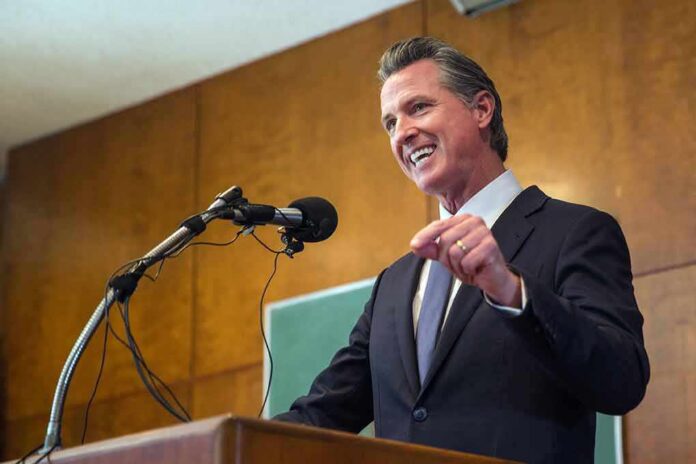
Gov. Gavin Newsom’s remarks about his academic record came during his final State of the State address in January 2026, when he veered from prepared text and spoke candidly about his own schooling. In the transcript and reporting, Newsom referenced a 960 SAT score and described an “inability to read the written text” that he said he has had to work through. The cited reporting places the comments in that speech setting, not a targeted pitch to any demographic group.
That distinction matters because the online narrative has increasingly recast the clip as Newsom telling a “Black crowd” he is “like them.” The research provided specifically flags that this framing does not align with the sourced material tied to the State of the State remarks. The available sources do not identify the audience as a Black crowd and do not describe the comments as an appeal to Black voters. Readers should treat versions of the claim that add crowd descriptors as unverified unless corroborated by primary video context.
California’s Test-Score Gains vs. the Readiness Gap Parents Can’t Ignore
Newsom’s ad-libbed confession came while he was touting education improvements and a brighter picture of the state’s trajectory. The administration highlighted statewide assessment gains for the 2024–2025 school year, describing student performance as exceeding both the previous year and pre-pandemic results across subjects and grade levels. The state announcement also emphasized progress among low-income students and among Black and Latino students. Those gains, if sustained, are meaningful—but they do not settle the broader argument over system performance.
Even with higher test scores and high graduation rates, California’s own readiness metrics underline why so many families remain skeptical of political victory laps. The research notes that roughly 9 in 10 students graduate, yet only 51.7% of graduates meet the state’s college-and-career readiness standard. That gap is difficult to square with rhetoric about equity and achievement, because the practical question for parents is whether a diploma reflects mastery. The numbers suggest too many students still leave school without strong fundamentals.
AB 1454 and the Literacy Push—Policy, Promises, and Accountability
In October 2025, the state promoted AB 1454 as a literacy-focused step intended to ensure educators and school leaders can access tools, training, and resources to improve reading outcomes. State officials credited what they described as sustained investments aimed at reducing inequities, including community schools and added student supports. Whether those approaches deliver broad, durable improvements will depend on implementation and transparency—especially because literacy is foundational and measurable. The political messaging may shift, but reading outcomes are a hard reality families see at home.
Politics Around the Speech: Competing Narratives on Cost of Living and Results
Newsom’s final State of the State address drew sharp pushback from opponents who argue that everyday affordability and governance outcomes tell a different story than his optimistic tone. The research references Republican criticism focusing on cost of living, gas prices, housing affordability, and education outcomes, contrasting that with Newsom’s defense of his record. The same research also notes a federal jab at Newsom’s California narrative. For voters who prioritize limited government and competence, the central issue remains performance—not slogans.
https://twitter.com/GovPressOffice/with_replies?lang=en
One clear takeaway from the sourced material is that the most viral version of the controversy mixes verified and unverified elements. Newsom’s SAT and reading comments are documented in the context of his State of the State remarks, while claims about him saying it to a “Black crowd” are not supported by the sources summarized in the research. In an era when political clips travel faster than transcripts, conservatives have a strong case for demanding receipts—especially when education outcomes affect family stability and a child’s future more than any talking point.
Sources:
What Happened When Gavin Newsom Sent a Surge of State Troopers to Fight Crime in Oakland
Newsom’s Final State of State Speech Steeped in Rosy View of California, His Record as Governor