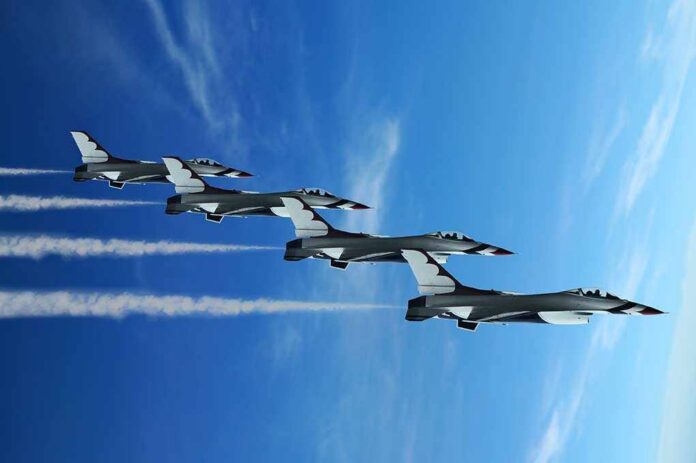
Three U.S. F-15E Strike Eagles fell from the sky in Kuwait due to friendly fire from allied defenses, echoing a deadly 2003 tragedy and exposing vulnerabilities in America’s fight against Iranian aggression under President Trump’s resolute leadership.
Story Snapshot
- Three advanced F-15E jets crashed on March 1, 2026, from Kuwaiti air defense friendly fire during Operation Epic Fury against Iran—all six crew members ejected safely.
- U.S. Embassy in Kuwait ordered Americans to shelter in place amid Iranian missile and drone threats targeting U.S. bases.
- Iran falsely claimed responsibility, but CENTCOM confirmed allied mistake in chaotic skies near Ali Al Salem Air Base.
- Incident repeats 2003 Patriot shootdown of RAF Tornado near the same base, raising questions on coalition coordination.
Incident Timeline and Details
Three U.S. F-15E Strike Eagles crashed over Kuwait on March 1 at approximately 7 p.m. local time during Operation Epic Fury. Videos captured the jets in flat spins with flames and missing vertical tails near Ali Al Salem Air Base. All six crew members ejected safely and received recovery in stable condition. CENTCOM attributed the losses to mistaken identification by Kuwaiti air defenses amid intense combat with Iranian aircraft, missiles, and drones.
Operation Epic Fury Context
Operation Epic Fury, now in its third day as of March 2, 2026, responds to Iranian strikes on U.S. bases in Kuwait, including a weekend attack that killed three U.S. Army soldiers. Kuwait hosts critical U.S. facilities like Ali Al Salem and Ahmad al-Jaber, both within Iranian missile range. The high-threat environment features mixed defenses such as Patriots, creating chaotic airspace that led to the friendly fire incident. President Trump’s administration directs these operations to counter Iranian disruptions decisively.
Stakeholder Responses and Coordination
CENTCOM issued a statement confirming Kuwaiti defenses mistakenly shot down the jets and expressed gratitude for Kuwaiti recovery efforts. The Kuwaiti Ministry of Defense verified several U.S. aircraft crashed with all crews safe and initiated joint technical measures with U.S. forces. Pentagon chief Pete Hegseth scheduled a March 2 press conference at 8 a.m. ET to address the situation. U.S.-Kuwait alliance remains strong despite the mishap, focused on shared defense against Iran.
The U.S. Embassy in Kuwait warned of ongoing missile and drone threats, ordering shelter-in-place for all U.S. personnel and citizens. This directive protects Americans amid sustained Iranian attacks on bases. No further crashes occurred as of March 2 afternoon, with investigations probing Identification Friend or Foe (IFF) system reliability.
Historical Parallel and Implications
This event mirrors a March 23, 2003, incident where a U.S. Patriot battery downed an RAF Tornado GR4 near Ali Al Salem, killing two crew members. The repeat after 23 years underscores persistent challenges in coalition operations under pressure. Short-term, airspace coordination faces hurdles, potentially pausing flights. Long-term, it prompts IFF technology upgrades for Patriots and similar systems.
US Embassy Orders Americans to Shelter in Place as F-15 Fighter Jets Fall From Sky in Kuwait https://t.co/rL9EeUyZm5
— The Gateway Pundit (@gatewaypundit) March 2, 2026
Aircraft losses exceed $240 million, with operational disruptions in the Middle East campaign. Social anxiety rises among Kuwaiti civilians and U.S. expats. Politically, it heightens tensions with Iran, whom analysts dismiss for the shootdowns due to distance factors. President Trump’s leadership emphasizes force protection, alerting Americans to these risks while debunking enemy propaganda.
Sources:
F-15 Spins Into The Ground While On Fire In Middle East
US F-15 fighter jet crashes in Kuwait
F15 jets Kuwait crash friendly fire