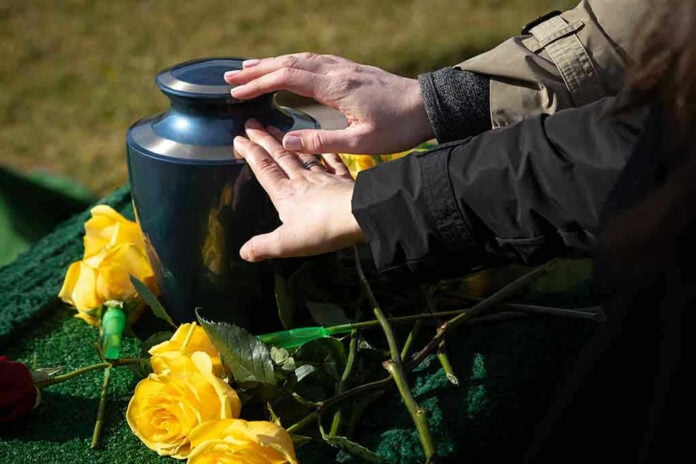
A Colorado funeral-home scandal so grotesque it defies basic decency is now ending in a prison sentence measured in decades—after families were handed fake ashes while nearly 200 bodies decomposed in secret.
Quick Take
- Jon Hallford, owner of Return to Nature in Penrose, Colorado, received a 30–50 year state sentence for corpse abuse on top of a prior 20-year federal fraud sentence.
- Investigators found about 189 decomposing bodies stored for years in a 2,500-square-foot building after reports of a foul odor.
- Families paid for cremations but were given fake ashes; reporting said some ashes were made from Quikrete.
- The Hallfords also took nearly $900,000 in pandemic-era PPP money, according to federal fraud findings summarized in the reporting.
- The case exposed weak oversight in Colorado’s funeral-home system and pushed lawmakers toward regulatory overhaul.
A Decades-Long Sentence for a Betrayal of Public Trust
Colorado courts have now stacked harsh consequences onto one of the most disturbing funeral-home cases in recent U.S. memory. Jon Hallford, who ran Return to Nature Funeral Home in Penrose outside Colorado Springs, was sentenced in February 2026 to 30–50 years in state prison for corpse abuse, in addition to a previously imposed 20-year federal sentence tied to fraud. Together, those penalties amount to 50–70 years behind bars.
The state case centered on what authorities said was an extended pattern of storing human remains instead of providing the services families paid for. The reporting describes bodies piled throughout the building, sometimes blocking doorways, with decomposition fluids on the floors. Officials said some remains had been left for years, not days, reflecting a breakdown that was not a simple administrative failure but a sustained abandonment of basic duties owed to the dead and the living.
How the Scheme Worked: Bodies Hidden, Families Deceived
The operational model was simple on paper: families entrusted Return to Nature with loved ones for cremation, expecting timely handling and honest return of ashes. The reported reality was the opposite. Rather than completing cremations, investigators said Hallford stored bodies in a 2,500-square-foot office building over roughly four years. When the truth surfaced, families learned the ashes they had buried or kept were not their loved ones’ remains.
The discovery unfolded after investigators received a tip about a foul odor in October 2023, leading them to the building where about 189 bodies were found. Jon Hallford and Carie Hallford were later arrested in Oklahoma in November 2023. By December 2025, a judge accepted plea deals for both defendants. Carie Hallford’s sentencing was scheduled for April 2026, meaning some legal accountability was still pending at the time of the latest report.
Federal Fraud Layer: PPP Money and Customer Payments
The case also carried a financial trail that widened the public outrage. Reporting summarized federal findings that the Hallfords defrauded the government of nearly $900,000 in Paycheck Protection Program aid during the pandemic era, while simultaneously collecting money from customers expecting cremation services. The same account said the couple spent lavishly despite mounting unpaid bills. Exact totals for customer losses were not fully specified in the available source material.
For families, the financial angle is inseparable from the moral injury. A grieving family’s payment for cremation is not a luxury purchase; it is part of a final act of love, closure, and religious or cultural practice. When that transaction is exploited, the harm becomes multi-layered: emotional trauma compounded by the realization that a solemn duty was converted into a cash-flow scheme. The reporting indicates the fraud and corpse-abuse conduct ran in parallel.
Victims’ Trauma and the Hard Work of Identifying Remains
Victim statements captured in the reporting show how deep the damage went. Derrick Johnson, whose mother Ellen Marie Shriver-Lopes was among the victims, described how learning the ashes he buried were not his mother’s triggered post-traumatic stress disorder. He also told the court that while bodies “rotted in secret,” the defendants “lived, they laughed and they dined,” suggesting the families’ money helped fund comforts like travel and spa visits, according to his testimony.
The investigative process also revealed why this kind of misconduct shakes public confidence: families cannot easily verify what happens after they sign paperwork and hand over remains. The reporting noted that the FBI used identifiers such as fingerprints, hospital bracelets, and medical implants to help sort and identify bodies. That reality underscores how much trust families must place in funeral providers—and how catastrophic it is when government oversight fails to catch years of abuse.
Regulatory Lessons: When Oversight Is Too Lax, the Public Pays
Colorado lawmakers began overhauling funeral-home regulation in response to the case, according to the reporting, after it exposed how weak oversight can allow prolonged abuse to go undetected. The available research does not provide full details of the new rules, inspections, or enforcement mechanisms, but the direction is clear: the scale of the discovery became a catalyst for reform. For conservatives who value accountability, this is the core lesson—standards must exist, and regulators must actually enforce them.
Limited data from a single primary source leaves some unanswered questions, including precise totals for customer fraud and the full scope of ongoing restitution or civil litigation. Still, the case’s essentials are firmly documented: bodies stored for years, families deceived with fake ashes, and major prison time imposed. The public takeaway is not partisan, but it is fundamental: when institutions—private or public—fail at basic responsibility, ordinary families are the ones forced to carry the cost.
Sources:
Colorado Funeral Home Owner Sentenced for Stashing Nearly 200 Decaying Bodies