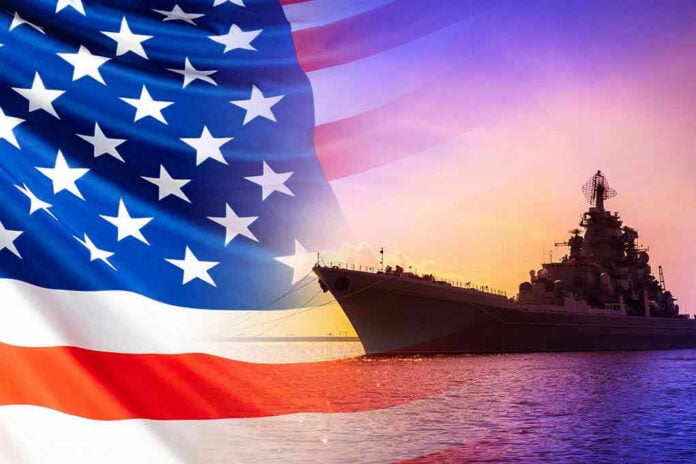
China’s navy now dwarfs America’s in sheer numbers, yet our superior technology and experience hold the line—while endless foreign entanglements like the Iran war drain resources we desperately need at home.
Story Snapshot
- China’s PLAN boasts 730-1,036 ships in 2026 versus U.S. Navy’s 465-472, confirming long-predicted numerical overtake.
- U.S. maintains decisive edges in aircraft carriers (11 vs. 3), stealth fighters like F-35s, and battle-tested submarines.
- Projections show China hitting 435 ships by 2030, but qualitative gaps in airpower and logistics persist.
- This arms race strains U.S. shipbuilding amid Trump’s Iran commitments, fueling MAGA debates on endless wars.
China’s Numerical Surge Confirmed
China’s People’s Liberation Army Navy (PLAN) surpassed the U.S. Navy in total ships by 2020, as Pentagon predictions from 2015 materialized. End-2024 counts showed PLAN at 370 vessels against U.S. 290. By 2026, rankings place China at 730-1,036 assets compared to U.S. 465-472. This growth stems from post-1991 reforms, civil-military fusion, and rapid production of frigates, corvettes, and Type 055 destroyers. DoD reports note PLAN dominance in smaller craft, though counts vary by inclusion of patrol vessels.
China’s Navy Is Now Bigger Than the U.S. Navy: That’s Not the Real Problemhttps://t.co/DtSsWLneIr
— 19FortyFive (@19_forty_five) March 30, 2026
U.S. Qualitative Superiority Prevails
U.S. carriers number 11 to China’s 3, enabling launches of 90 F-35C stealth fighters per group—China’s J-35 remains in very small numbers without mature carrier wings. America leads in destroyers (78 vs. 58), tonnage, and advanced submarines (71 vs. 73, but superior nuclear tech). Hypersonic upgrades like Conventional Prompt Strike on Zumwalt-class narrow gaps. Experts emphasize warfighting quality over hull counts, with U.S. alliances like AUKUS bolstering Pacific deterrence. PLAN prioritizes A2/AD for regional claims like Taiwan and South China Sea.
Historical Buildup and Key Players
PLAN expansion accelerated after the 1996 Taiwan Strait Crisis and Gulf War lessons, shifting from coastal defense to blue-water ambitions. Xi Jinping drives this via industrial scale; U.S. leaders like SecNav Carlos Del Toro and CNO Adm. Lisa Franchetti focus on F-35s and hypersonics. Rep. Rob Wittman warns of the surge, pushing recapitalization. Power dynamics pit China’s quantity against U.S. tech and allies. Recent additions include Fujian carrier, Type 076 amphibs, and YJ-21 missiles, yet logistics and experience lag.
In 2026, as Trump navigates the Iran war, these naval realities heighten Indo-Pacific risks without new American boots on distant shores—echoing frustrations over broken promises to avoid regime-change quagmires.
Implications for American Priorities
Short-term, U.S. air superiority deters Taiwan or South China Sea aggression, protecting allies like Japan and Australia. Long-term, China’s quality gains by 2030 challenge dominance, straining U.S. procurement amid slower shipbuilding. Economic boosts to China’s industry contrast American cost overruns. Politically, it fuels defense debates as Iran drains focus—reminding conservatives why “America First” rejects globalist overstretch. Global trade routes face vulnerability, but quality, not quantity, wins high-end fights.
Sources:
https://worldpopulationreview.com/country-rankings/largest-navies-in-the-world
https://www.globalfirepower.com/navy-ships.php
https://warriormaven.com/news/china/can-china-s-larger-navy-rival-the-us-navy
https://www.globalmilitary.net/compare/navies/chn-vs-usa/