

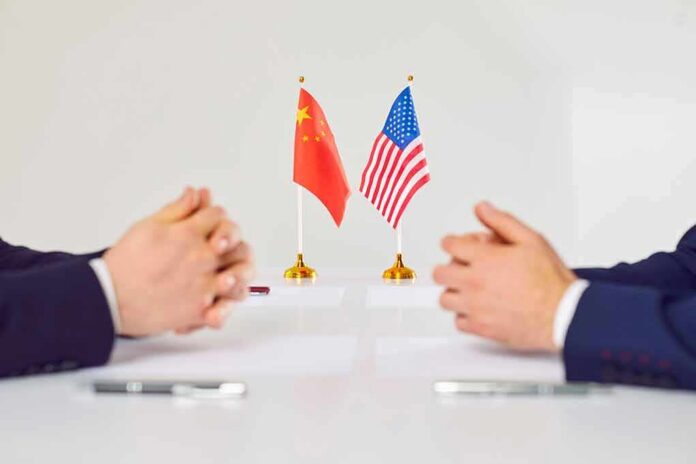
President Trump, China’s Xi, and Russia’s Putin are set to meet in Shenzhen for a first-of-its-kind nuclear-focused summit confirmed by the White House, underscoring both risk and opportunity for global security.
Story Highlights
- White House confirms a trilateral Trump–Xi–Putin meeting in Shenzhen, calling it unprecedented.
- Trump plans to press nuclear-arms risk reduction as his top priority.
- Officials do not expect a signed agreement; talks aim to open a channel.
- Ukraine and Taiwan are not listed agenda items in current reporting.
What Is Confirmed About the Shenzhen Meeting
White House officials said President Trump will join China’s Xi Jinping and Russia’s Vladimir Putin for an unprecedented three-way summit in Shenzhen this month. Reports describe the gathering as the first of its kind among the heads of the world’s largest nuclear powers, planned alongside Asia-Pacific meetings in China. The format sets three nuclear states at one table. That arrangement raises the stakes but also creates a direct line to manage crises that could spill across borders.
U.S. officials and media reports say nuclear risk reduction will anchor the talks. A White House spokeswoman said Trump wants to discuss reducing global nuclear arsenals. Coverage adds that the administration views nuclear proliferation as a major danger that demands leader-level engagement. This aligns with a broader shift from bilateral to three-way competition, after past treaty limits fell away and transparency eroded. Leaders often use early summits to set terms, then pursue details later.
Why Nuclear Dialogue Matters Now
Washington and Moscow currently operate without binding caps on strategic forces for the first time since the early 1970s. China has expanded its arsenal outside any formal transparency regime, making the balance more complex and less predictable. Direct talks can help avoid mistakes, even without a treaty. Past summitry shows outcomes often arrive in stages: reopen contact, share red lines, then test small steps that build trust over time, rather than leap to a grand bargain.
Analysts note that trilateral arms control is harder than the old United States–Russia model. The three sides hold different force sizes, threat views, and verification preferences. China has long argued its smaller stockpile should not face the same cuts as the United States or Russia. That stance complicates shared limits or inspections, and makes modest confidence-building steps more likely than sweeping reductions at the outset.
What Will Not Be on the Table, According to Reports
Reports state that Ukraine is not part of the trilateral agenda, and none of the governments has listed Taiwan as a topic for this meeting. That narrows the focus to nuclear risk, and perhaps ancillary security concerns such as launch notifications or crisis hotlines if leaders choose to explore them. U.S. officials have also set expectations: no formal agreement is anticipated from this session. The intent is to start a process rather than finalize a deal.
Historic Meeting Three major powers…🤔
Trump–Xi–Putin three nuclear arsenals,one table a potentially historic moment for global security.🪩Date: November 19, 2026.
Venue: Shenzhen, China, during the APEC summit.
🪩First-ever trilateral meeting of US,China and Russia's leaders…— Santosh kumar jain (@Santosh37356413) November 15, 2026
Public debate will still track the broader context. On the right, many worry that globalism and weak policy have fed danger abroad and higher costs at home. On the left, many fear that “great power” dealings can sideline smaller nations and widen the gap between elites and everyone else. A trilateral among nuclear powers can look like both a needed safety valve and a closed-door club. The test is whether open channels reduce risk without cutting out those most affected.
What Trump Could Seek to Gain
President Trump could try to secure basic guardrails that lower the odds of a crisis. Options include renewed leader hotlines, advance notice of missile tests, and shared understandings about risky deployments. Even small steps would mark movement from today’s drift, where fewer rules and more weapons raise the chance of misread signals. Given the lack of expected signatures, any win would likely be a practical measure that can be expanded later if trust grows.
Strategically, the meeting lets Washington see how Beijing and Moscow frame their nuclear goals face to face. It also lets the United States press for more transparency from China, which has operated outside traditional limits. These talks will not settle bigger disputes. But they can set a floor under the worst risks while leaders keep arguing about trade, technology, and regional conflicts. That is not flashy. It is crisis management in a tense era.
Why This Matters for Americans
Americans across the spectrum feel the system is not working. Families see high prices, rising energy costs, and leaders who argue more than they deliver. A direct line between the three top nuclear powers will not fix paychecks or gas bills. But it can reduce the chance of a mistake that would dwarf every other problem. If the summit trades photo-ops for real safety steps, it serves the public. If not, it is another meeting that puts process over results.
Sources:
theamericanconservative.com, cbsnews.com, repubblica.it, newsday.com, fresnobee.com, apnews.com
© newsworthy.news 2026. All rights reserved.