

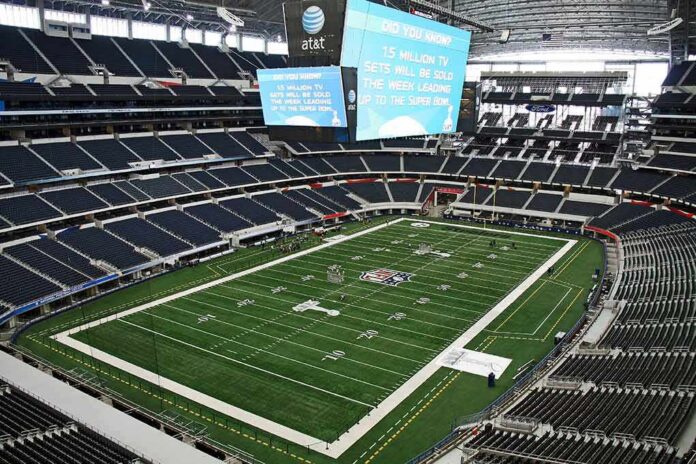
Dallas Cowboys owner Jerry Jones said the National Football League could move to an 18-game season as soon as 2027, trading preseason games for regular-season ones.
Story Snapshot
- Jerry Jones floated an 18-game regular season starting as early as 2027, with fewer preseason games.
- Any change must be bargained with the players’ union under the current labor deal.
- Players and union leaders warn that adding a game raises health and safety concerns.
- The league expanded to 17 games in 2021, creating precedent but also new debates.
What Jones Proposed And When He Said It
Jerry Jones told a Dallas radio audience on November 13, 2026, that an 18-game schedule could arrive “next year, maybe,” or by 2027. He said teams would trim preseason games and use early regular-season weeks to develop players. Jones argued the shift would help all sides, including players, and called it “in everybody’s best interest.” His comments were specific on timing and the preseason tradeoff rather than vague support for expansion.
Jones also linked the idea to economics in prior comments reported elsewhere. He has suggested an added game would grow league revenue and that players could share in more than a billion dollars in added pay, though he did not release a public model that details the assumptions or payout formula. That lack of a transparent calculation leaves open questions on how extra income would be split across veterans, rookies, and practice-squad players.
The Rules Of The Road: Labor Deal And Negotiations
Jones acknowledged that owners cannot act alone. Any schedule change must be negotiated with the National Football League Players Association under the existing collective bargaining agreement. Reporting this year has noted that formal talks on 18 games had not begun when league leaders were last asked, and the current agreement already codifies a 17-game schedule. That reality makes a 2027 launch dependent on reaching terms in time.
The recent past shows how this could work. The league moved from 16 to 17 regular-season games in 2021 after collective bargaining, swapping out a preseason game and adjusting revenue sharing. Independent research on that first step found no statistically significant change in overall musculoskeletal injury rates between the 16- and 17-game eras, though that analysis does not settle questions about an 18th game’s impact.
Player Pushback: Health, Pay, And Workload
Union leaders and several players have pushed back. National Football League Players Association executive director Lloyd Howell said 17 games already feels too long for many players and that injuries can carry into the next season. Running back Austin Ekeler labeled 18 games “outrageous.” Their core argument is simple: more meaningful snaps mean more hits, longer recovery, and mental strain, even if preseason is shorter.
Some stars tied the issue to pay as well as health. Tight end George Kittle said the 17th game increased workload without improving his per-game pay, and he warned that injury counts were already high. Players note that preseason snaps are often lighter for starters, while regular-season snaps are full speed and count in the standings. That makes a clean swap hard to judge on safety alone without better data and clear protections.
What Evidence Exists On Injuries And Exposure
Past studies give a mixed picture. One peer-reviewed paper comparing the 17-game season to the prior 16-game years found injury rates of 18.4 versus 19.7 per 1,000 athlete-exposures, a difference that was not statistically significant. This suggests the 2021 change, by itself, did not raise overall musculoskeletal injuries. However, that finding does not automatically extend to 18 games, which would add another week of high-intensity play.
League health officials have also argued that preseason games carry higher injury rates per exposure and that cutting one preseason game while adding a regular-season game did not increase total injuries after the 2021 shift. Still, the key unknowns for 18 games include bye-week structure, roster sizes, recovery rules, and international travel. Without those details, it is hard to judge true exposure and risk across the full season.
The Money Question And The Fan Experience
An extra regular-season week likely increases television, ticket, and sponsor revenue, which can lift the salary cap and player earnings. Fans also get more meaningful games. But more games can dilute late-season quality if injuries stack up, and mid-roster players may not see pay keep pace with risk if contracts lag behind a new calendar. Clear pay formulas, guaranteed money, and expanded benefits would make the tradeoff easier to evaluate for both sides.
For a deal to land, both camps need shared facts. Independent medical studies on injury load and recovery under an 18-game model would help. A transparent financial model showing added revenue and exact player shares would help too. Until then, Jones’s timeline is aspirational, not assured. The path runs through the bargaining table, where health protections, pay, and schedule design will decide whether the idea moves from talk to kickoff.
Sources:
yardbarker.com, scoutfly.cbsistatic.com, clutchpoints.com, thescore-web-gcp.thescore.com, sports.yahoo.com, frontofficesports.com, theolympian.com, nfl.com
© newsworthy.news 2026. All rights reserved.