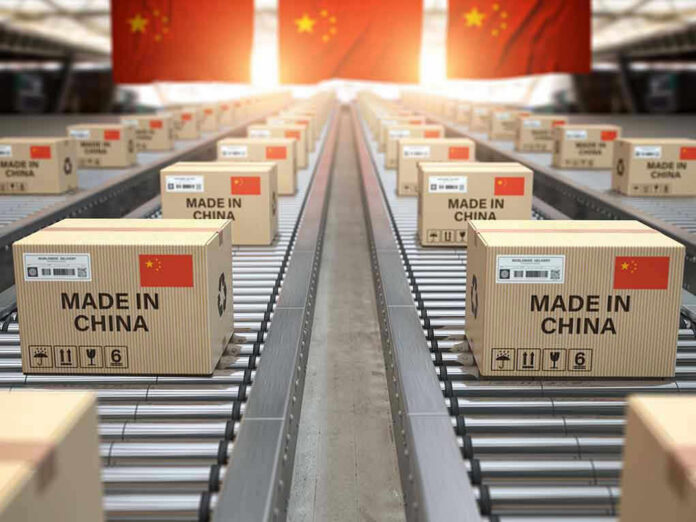
China just turned its trade laws into a weapon against American defense companies, and it is a direct shot at U.S. power, supply chains, and national security.
Story Snapshot
- China banned exports of key “dual-use” goods to ten American defense-linked firms in open retaliation for new U.S. sanctions.
- Beijing is using a new export-control law to target drone makers and rare earth companies that feed the U.S. military supply chain.
- This move fits a growing tit-for-tat spiral where both sides are weaponizing trade, tech, and investment rules.
- Everyday Americans could feel this through higher costs, weaker deterrence, and more leverage in China’s hands over critical materials.
China’s New Trade Weapon Aims at U.S. Defense Supply Chains
China’s Ministry of Commerce announced sanctions on ten American defense-related companies after Washington tightened limits on Chinese tech giants receiving U.S. defense contracts.[2] Beijing barred Chinese firms from exporting any “dual-use” products to these companies, including military drone makers and rare earth miners that support the Pentagon’s needs.[2] Dual-use items are products that can be used for both everyday civilian purposes and sensitive military applications, which means the impact can reach deep into many supply chains.[2]
The United States had just expanded its own lists of Chinese companies tied to the People’s Liberation Army, blocking them from Pentagon contracts and cutting access to critical U.S. technology.[10] China answered by turning its new dual-use export-control regime against American targets, using the same “national security” language Washington uses for chip controls.[2][4] For patriotic readers, this is not a random trade spat; it is part of a long struggle over who controls the tools of modern warfare and advanced manufacturing.
How Beijing’s Dual-Use Law Gives It a Free Hand to Squeeze America
China’s State Council approved a new Regulation on the Export Control of Dual-Use Items that took effect in December 2024.[3] That rule defines dual-use goods broadly as items, technologies, and services with both civilian and military uses, especially anything that can boost military potential or support weapons of mass destruction.[6] The regulation gives China’s Ministry of Commerce power to decide which technologies count as dual-use and which foreign users are allowed to receive them, including the power to ban or restrict exports outright.[6]
Under this system, Chinese officials can block exports to specific companies, regions, or sectors whenever they say national security or national interests are at risk.[3][6] A major law firm analysis notes that exporters must provide detailed information about end users and end uses, and must stop shipments if those change or appear risky.[5] In practice, that means Beijing now has a legal switch it can flip to shut off critical inputs to foreign defense firms, whether they are in Europe, Taiwan’s partners, or the United States.[6] This is exactly the tool it is now using on American defense-linked companies.
A Tit-for-Tat Tech War That Reaches Into American Jobs and Wallets
Washington is not innocent in this fight; the United States has led with sweeping export controls on advanced chips and semiconductor tools going into China.[1][4] The U.S. Department of Commerce has tightened rules since 2022 to block China from getting high-end computing chips, chipmaking gear, and related services, all in the name of national security.[1][4] These measures are meant to slow China’s military advances in fields like artificial intelligence, supercomputing, and modern weapons systems, and they have strong support among many national security conservatives.
China is now copying the playbook in its own way, targeting rare earth suppliers, drone makers, and other firms that plug directly into U.S. defense and space programs.[2][10] Rare earth elements are vital for missiles, fighter jets, precision-guided weapons, and many electronics, and China still dominates much of that mining and processing.[10] When Beijing says no dual-use exports to these firms, it is not only signaling anger; it is reminding America that our supply chains remain dangerously exposed to a hostile regime that rejects Western-style freedom and uses trade as leverage.[2]
Symbolic Move or Serious Warning Shot for Trump’s America?
Analysts note that many of the newly hit U.S. firms do not have large business operations inside China, so this round may be more symbolic than a full-blown economic attack.[10] But symbolism matters in geopolitics, and China paired this export ban with another step: its Finance Ministry barred forty-six mostly defense-linked U.S. firms from taking part in Chinese government procurement.[10] Together, those actions show Beijing is willing to mix trade tools, legal tools, and political messaging to push back against U.S. pressure and to rally its own nationalist base.
China blacklisted MP Materials & USA Rare Earth – the Pentagon's pick to break rare earth dependence. Reality: MP runs America's only rare earth mine – but ore goes to China for processing.
The US funded mining, not refining. By blocking dual-use exports, China weaponized a…
— Benniji (@BennyLam) June 22, 2026
For American conservatives, this should raise two alarms at once. First, it proves our long-term reliance on hostile supply chains was a mistake pushed by globalist elites and big business, not by Main Street America. Second, it shows why strong, clear policy from the Trump administration is needed to bring critical mining, manufacturing, and advanced tech home where Beijing cannot flip a legal switch and strangle our defense base. Without that shift, every new U.S. sanction on Chinese bad actors will invite another Chinese move aimed straight at our own industrial and military muscle.
Sources:
[1] Web – China Hits Back at US Sanctions on Tech Giants, Restricting Its …
[2] Web – What China’s New Export Controls Mean for the U.S. Defense …
[3] Web – Adapting to Change: Understanding China’s Updated Export Control …
[4] Web – China issues regulations on export control of dual-use items
[5] Web – Regulation of the People’s Republic of China on Export Controls for …
[6] Web – China – U.S. Export Controls – International Trade Administration
[10] Web – New Restrictions on Chinese Military Companies | ECTI
© newsworthy.news 2026. All rights reserved.