
Swiss researchers deployed a four-legged robot to autonomously monitor toxic volcanic gases on Mount Etna, achieving what wheeled systems and human teams couldn’t—safe, reliable data collection in one of Earth’s most hostile environments.
Story Snapshot
- ETH Zürich’s quadruped robot achieved over 90% autonomy during four Mount Etna missions, detecting sulfur dioxide and carbon dioxide emissions
- Legged design outperformed previous wheeled robots on steep volcanic terrain, navigating crater rims, lava fields, and unstable ground
- System integrated mass spectrometry for real-time gas detection, matching handheld measurements without risking human lives
- Technology offers scalable framework for global volcanic monitoring, disaster response, and extreme environment exploration
Robotic Innovation Tackles Volcanic Hazards
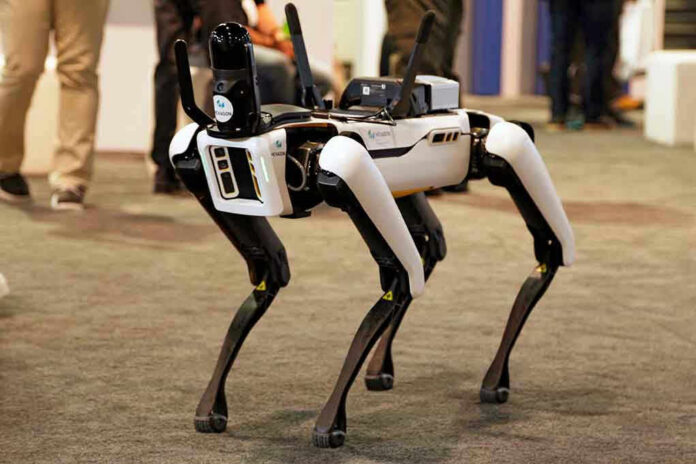
ETH Zürich’s Robotic Systems Lab successfully deployed a quadruped robot equipped with a quadrupole mass spectrometer on Mount Etna in Sicily during four field missions. The robot dog navigated Sicily’s 3,300-meter active volcano, mapping emissions from natural fumaroles and artificial sources at Silvestri Crater and Legetto Crater. The system detected critical volcanic gases including sulfur dioxide and carbon dioxide, achieving autonomy rates exceeding 90 percent. This development addresses longstanding safety challenges where toxic fumes, unstable terrain, and steep inclines have historically prevented effective ground-level monitoring.
Superior Mobility Over Previous Systems
Previous wheeled robots failed on Etna’s challenging topography, unable to traverse loose volcanic soil and rugged lava formations. The legged design demonstrated superior adaptability, successfully completing crater rim traverses, steep descents, and volcanic desert navigation. Team members including Julia Richter, Marco Hutter, and their colleagues developed a modular autonomy stack featuring terrain-aware navigation and global localization capabilities. The robot matched handheld reference measurements previously requiring dangerous human fieldwork, validating the system’s accuracy while eliminating personnel risk in hostile environments.
Practical Applications Beyond Volcanology
The technology reduces fieldwork costs and logistics compared to human monitoring teams while enhancing public safety for Sicilian communities and air traffic operations. Mount Etna’s frequent eruptions and recent ash emissions underscore the need for continuous ground-level data collection to support aviation alerts and eruption forecasting. The validated system framework extends beyond volcanic monitoring to potential applications in disaster response, mining operations, and planetary exploration scenarios. This practical advancement in robotics demonstrates American-style innovation prioritizing safety and efficiency over government-dependent human risk.
Field-Tested Engineering Excellence
The ETH team conducted three autonomous missions plus one teleoperated exploration for natural fumarole sampling, documenting lessons for improved gas analysis and long-range operations. The robot successfully operated in Legetto Crater’s unstable interior terrain despite challenging conditions. Published findings released January 9, 2026, detail the system’s terrain navigation capabilities and sensor integration through an arXiv preprint. Academic leadership from institutions like ETH Zürich showcases how focused research solves real-world problems without bloated bureaucracy, delivering measurable results through engineering expertise rather than wasteful spending programs.
Sources:
Dramatic moment Italy’s Mount Etna spews thick clouds of volcanic ash – prompting aviation warning