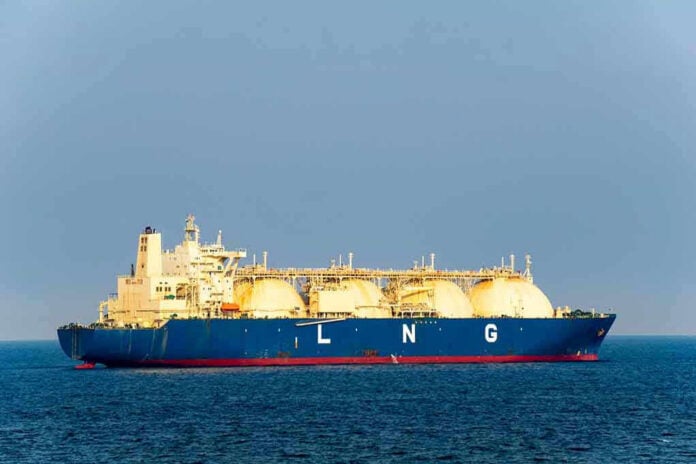
President Trump announced that massive numbers of empty oil tankers are racing to American ports to load up on U.S. crude, showcasing America’s energy dominance while Iran’s Strait of Hormuz blockade cripples global oil flows and drives prices up over 30 percent.
Story Snapshot
- Approximately 100 empty supertankers, each capable of carrying 2 million barrels, are heading to U.S. Gulf ports as Iran’s Strait of Hormuz closure disrupts global energy markets
- Brent crude oil prices surged to $97 per barrel, up more than 30 percent since late February when Iran closed the critical maritime chokepoint
- Trump emphasized U.S. oil superiority, claiming America has more reserves than the next two largest oil economies combined with higher quality “sweetest” crude
- Vice President JD Vance is overseas conducting peace talks to resolve the Iran conflict and reopen the Strait of Hormuz
America Steps Up as Global Energy Lifeline
President Donald Trump revealed on Truth Social early Saturday morning that unprecedented numbers of completely empty oil tankers are making their way to the United States to secure American crude. The president’s announcement, accompanied by a map tracking roughly 100 massive vessels, underscores how global energy buyers are turning to the U.S. as Iran’s blockade of the Strait of Hormuz continues strangling traditional supply routes. Trump promised a “quick turnaround” for these tankers, emphasizing America’s readiness to fill the gap left by the Middle East crisis. This development represents a tangible win for energy independence advocates who have long argued that domestic production protects America from foreign manipulation.
Iran’s Stranglehold Reshapes Energy Markets
The Strait of Hormuz, a 21-mile-wide chokepoint between Iran and Oman, has historically handled 20 to 30 percent of global oil trade. Iran closed this critical waterway in late February 2026 amid escalating conflict with Israel and U.S. interests, forcing commercial vessels to avoid the route entirely. According to Associated Press data, only about 12 vessels have transited the Strait following a recent ceasefire, far below normal traffic levels. The closure has disrupted not just oil flows but also natural gas and fertilizer shipments, sending shockwaves through global commodity markets. Brent crude prices climbed to $97 per barrel by April 11, reflecting the severe supply constraints created by Iran’s strategic move.
Trump Touts Superior American Oil Quality
The president characterized U.S. crude as the “best and sweetest oil and gas” available worldwide, highlighting the light, sweet crude produced in the Gulf of Mexico and Permian Basin. Trump stated that America possesses more oil reserves than the next two largest oil economies combined, positioning the nation as the world’s most reliable energy supplier. The approximately 100 tankers heading to U.S. ports represent a combined capacity of roughly 200 million barrels, a staggering volume that could significantly ease global supply pressures. Trump framed U.S. efforts to help clear the Strait of Hormuz as a “favor” to other nations, though America clearly benefits from the crisis by capturing market share from Middle Eastern competitors unable to deliver their product.
Diplomatic Push Alongside Energy Strategy
While tankers steam toward American shores, Vice President JD Vance traveled overseas on April 11 to conduct peace talks aimed at resolving the Iran conflict and reopening the Strait of Hormuz. The dual approach of leveraging U.S. energy dominance while pursuing diplomatic solutions demonstrates the Trump administration’s multipronged strategy. However, Iran continues wielding its geographic advantage over the critical chokepoint, maintaining pressure on global energy flows despite ceasefire discussions. The situation exposes the vulnerability of nations dependent on Middle Eastern oil, a weakness that decades of government policies discouraging domestic fossil fuel production exacerbated. Americans frustrated with previous administrations’ push toward renewable energy at the expense of energy security now see vindication in Trump’s approach prioritizing oil and gas production.
Empty Oil Tankers Are Racing to the US for Oil https://t.co/SsP0Qk9hh3
— Fearless45 (@Fearless45Trump) April 12, 2026
Economic Implications and Market Shifts
The redirection of tanker traffic to the United States carries significant economic consequences for multiple stakeholders. U.S. oil producers and Gulf Coast ports stand to gain substantially from the export surge, while traditional Middle Eastern exporters like Saudi Arabia lose market share they may struggle to reclaim. Global refiners desperate for crude are paying premium prices, with Brent crude’s 30 percent increase since late February reflecting the supply crunch. American consumers may face higher fuel prices in the short term, though increased domestic production could stabilize costs over time. The shift also benefits U.S. tanker operators commanding higher rates and reinforces the economic argument for domestic energy development that conservatives have championed against opposition from environmental activists more concerned with climate ideology than energy affordability and national security.
Sources:
‘Completely empty’ tankers heading to US to ‘load up’ with oil & gas: Trump – Turn To 10
‘Completely empty’ tankers heading to US to ‘load up’ with oil & gas: Trump – WCTI12
Trump: Empty oil tankers heading to US to load up with oil, gas – Baird Maritime
Trump says empty oil tankers heading to US to fill up on ‘sweetest’ oil and gas – Times of Israel
Trump says giant empty tankers headed to US for world’s best oil – Economic Times